




This article is jointly published with The Daily Utah Chronicle as part of collaborative coverage of the 2026 Sundance Film Festival.
The girls of “Extra Geography” move through their world as if nothing exists beyond it. Not adulthood, not consequence, not even time. They are, as the film insists from the very beginning, the center of the universe.
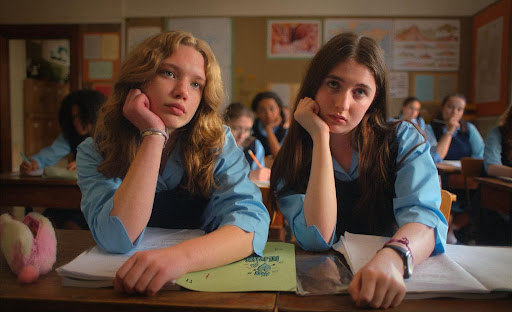
Directed by Molly Manners and written by Miriam Battye, “Extra Geography” is set in an all-girls boarding school following Flic (Marni Duggan) and Minna (Galaxie Clear). Based on Rose Tremain’s short story from the ’50s, the co-leads navigate girlhood and teenage friendship in this coming-of-age film.
When asked what brought this film to life, Battye noted that it was “outrageous how relevant it was to me. It felt like it kidnapped my memories,” she said. “When I was fifteen, I felt like I was the center of the universe, so I wanted to make a film where they were squarely the center of the universe.”
This perspective defines “Extra Geography.” Manners’ camera begins by tethering Flic and Minna together in the same frames, mirroring each other’s movement and synchronizing rhythms, before gradually allowing distance to creep in. The visual language falls apart, just as the characters’ stability does, substituting cohesion with negative space. What becomes of the film henceforth reminds the audience of a tragically relatable feeling.
The importance of female friendship
Manners said that she “wanted to play with the idea that teenage feelings are so all-consuming and deep, yet we often don’t have the tools to fully understand or articulate them.” Because of these feelings, the girls become “a survival mechanism for each other,” Manners said.
This dependency on friendship comes from the writer’s care for the subject. To Battye, “friendship is really romantic. It’s one of the most extraordinary things where you can find comfort, but also challenge yourself and find a lot of discomfort,” she said. “Friendship between women is my lifelong subject matter as a writer.”
Beautiful debut performances
Duggan and Clear, both making their professional screen debuts, have a powerful bond, both on screen and off. Their chemistry is immediate but never showy; it shows in glances, posture and physical proximity.
Offscreen, that connection developed just as organically. “We mirror each other without realizing,” Clear said while they smiled at each other. Duggan recalled moments of unscripted intimacy between them that naturally slipped into the film, reinforcing its sense of genuine closeness.
The friendship between Flic and Minna contains imbalance, competitiveness and fear, qualities often discouraged or villainized in girls. Here, they are allowed to exist without moral judgment. “Usually when people see those traits in women, it’s villainized,” Duggan noted. “But they’re an amazing quality that happens in a young girl.”
A film made about women, for women, by women
“Extra Geography” was shaped by its predominantly female creative team. Producer Sarah Brocklehurst worked closely with the rest of the team to make a welcoming environment, which was something both actresses described as transformative. “You were free and open to just … Be yourself and truly explore your character,” Duggan said. “It was all women; the director, the writer, the producer and that changed everything, in the most beautiful way.”
For these young actresses, the all-female team’s encouragement “fostered a great environment for us,” Clear said. This helped Clear and Duggan perform complex characters, where ambition, competitiveness, tenderness and uncertainty were able to coexist and reflect the depth of human relationships. The result is a film filled with the intensity, unpredictability and intimacy of early friendships.