




This article is jointly published with The Daily Utah Chronicle as part of collaborative coverage of the 2026 Sundance Film Festival.
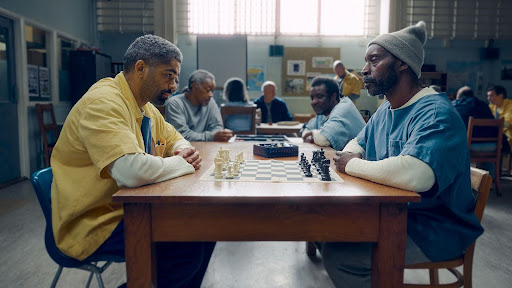
Sundance film “Frank & Louis” sparks conversations about rehabilitation versus punishment in the U.S. criminal justice system. Directed by Petra Volpe, the film centers on Frank (Kingsley Ben-Adir), an incarcerated man assigned to care for fellow prisoner Louis (Rob Morgan), a dementia patient. Through their relationship, Volpe comments on caregiving, aging and incarceration, and questions how a justice system built on punishment might change if it truly prioritized rehabilitation and human dignity.
Redemption over dehumanization
For Morgan, the film raises an uncomfortable question about the purpose of incarceration itself.
“The justice system is supposedly about redemption,” he said, “and let’s start a conversation making it more about redemption instead of punishment and dehumanization.” He did not shy away from naming what he sees in the justice system, one that is driven by profit and fear rather than rehabilitation. “But if we can go back and put it at the rehabilitation that it was originally created for, I hope that can be part of the conversation,” he said.
A crisis hidden in plain sight
Volpe was drawn to the story after learning about real-life peer caregiving programs in U.S. prisons, including the Gold Coats at California Men’s Colony. These programs rely on incarcerated men to care for other prisoners suffering from dementia and terminal illness. This is a reality few people outside the system ever consider.
“When you say the movie shows Alzheimer’s, dementia and prison together, people are struck,” Volpe said. “Because you never think about it.” Yet aging prisoners are the fastest-growing population in American prisons, a reality Volpe describes as both a societal and healthcare crisis.
“Prisons are not built to be nursing homes,” she said. “It opened up a whole new way of thinking for me about incarceration and aging.”
Volpe visited prisons in California and spent time with the men doing the caregiving work. The conversations she had with them became the emotional foundation of the film.
“Many of them told me, ‘This work made me feel human again.’ That sentence stayed with me as I made the film,” she said. Volpe stressed that this humanity was central to how she approached the film.
Rethinking masculinity
The film also challenges how masculinity, particularly Black masculinity, is portrayed on screen. Volpe said “Frank & Louis” is her first film centered on male relationships, and one she sees as deliberately anti-toxic masculinity. “There are very limited ideas of how men are shown,” she said. “Especially incarcerated men.”
Morgan hopes that audiences can learn from this film and “see a relationship between two men in this toxic environment that shows the need to caretake for someone else,” he said. “And hopefully, that’ll reflect back into society, so that we can take care of each other and find each other’s journeys just as important to us as our own.”
The film depicts men as caregivers, artists and emotional beings capable of deep compassion toward one another. “Dementia does not discriminate,” both Morgan and Volpe said. And yet stories about it are almost always told through wealthy, white families with resources.
“Nobody ever thinks about poor communities or incarcerated people who also suffer from this disease,” Volpe said. “It’s important to show the whole life cycle of who can be affected.”
Starting conversations
Volpe and co-producers Thembisa Cochrane and Georgie Page hope that “Frank & Louis” can expand how people think about incarceration, aging and care. “The movie raises complex questions, and the hope is to discuss them openly,” Volpe said.
At Sundance, the film has already found an audience willing to engage with those questions, many of whom admitted they had never considered what happens to elderly prisoners, or why someone who no longer understands their sentence is still being punished.
[1/29/26, 17:00] Editor’s note: A previous version of this article incorrectly referred to Petra Volpe as an Academy Award nominee. The article has since been updated.